Shop

Hops, High Desert, and Heritage: Inside Sierra Nevada’s Bold Bet on America’s National Parks
The rocks jutted out of the earth like ice cubes in a glass of whiskey—one, an elephant climbing up a staircase into the sky; the other a beluga whale cresting the surface, its head just visible.
“It is almost otherworldly out here,” said our guide, Conan Allen, founder of Joshua Tree Connectivity, which offers award-winning immersive experiences in one of the most frequented national parks in the entire country.
Despite welcoming over 3 million visitors a year, in our particular patch of Joshua Tree, we were completely alone.
Well, I wouldn’t say we were alone.
We met several of Conan’s friends, including a bevy of muted rainbow-colored rocks: a psychedelic, beautiful quartz, a gender-neutral one with red lipstick he’d take out on the town, and a mint-green-colored one like a stick of wintergreen gum.
“I don’t play favorites,” Conan said seriously with a sly grin. “I love all the flora and fauna out here.”
Despite the early-morning heat, Conan was covered head to toe. An olive green REI hat hid his head while Basset Hound Goodr sunglasses covered his eyes. A mustache and beard more pepper than salt shadowed his face.
The hood on a KUHL long-sleeve was pulled down along his forearms, exposing only the backs of his hands. Shapes snaked down the skin of his thumbs and pinkies like a jar of rattled dice, shaken and thrown haphazardly onto a craps table.
Out in the unforgiving high desert at over 3,000 ft, Conan seemed completely at ease. More than that, he seemed connected, drawn into the quietly humming ecosystem around him.
We couldn’t walk two feet without him stopping, excitedly pointing out an endemic variety of chia, one of seven in the park, or a Cheesebush, one of over forty medicinal plants in the area.
“Smells like dirty socks,” laughs Conan, “or fine cheese.”
Over and over again, as we sauntered for the next mile, he gushed, “Guys, I just have so much to share with you.”
Beauty surrounded us even when we couldn’t see it. What appeared as just a scraggly tree was the Pinyon pine, producer of pine nuts from which Conan made a salve for his mustache. A seemingly colloquial shrub was actually the Creosote Bush (Conan’s favorite), offering up medicinal properties that he uses every day.
“Joshua Tree is an energetic vortex,” Conan reminded us several times.
A synergy exists here in the high desert, where an otherworldly planet protects the cheapest natural grocery store for miles. In this canyon of interconnectivity, you’ll find a “delicate and delicious” ecosystem.
One worth protecting.
Those words hummed through me later that night as I cracked open a bottle of Sierra Nevada Pale Ale and started chatting with some new friends.
Splashed across the sweaty glass bottle, not the Sierra Nevada Mountains, but those same native brushes, namesake Joshua Trees, and striking rock formations we’d seen earlier on our hike.
Last year, Sierra Nevada began a partnership with the National Parks Foundation, the official nonprofit partner of the National Park Service dedicated to protecting the treasured landscapes of America’s over 400 national parks and 85 million acres.
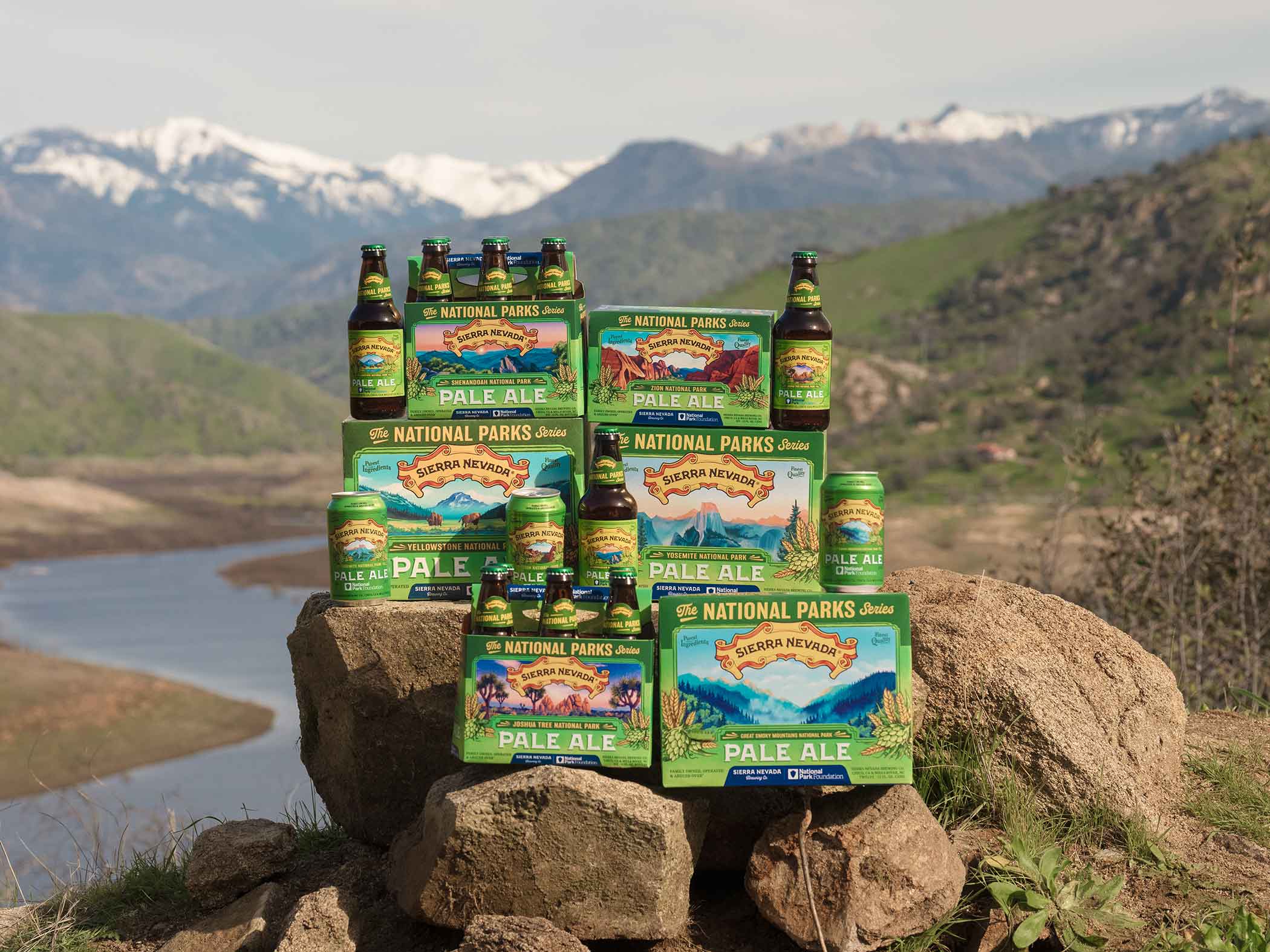
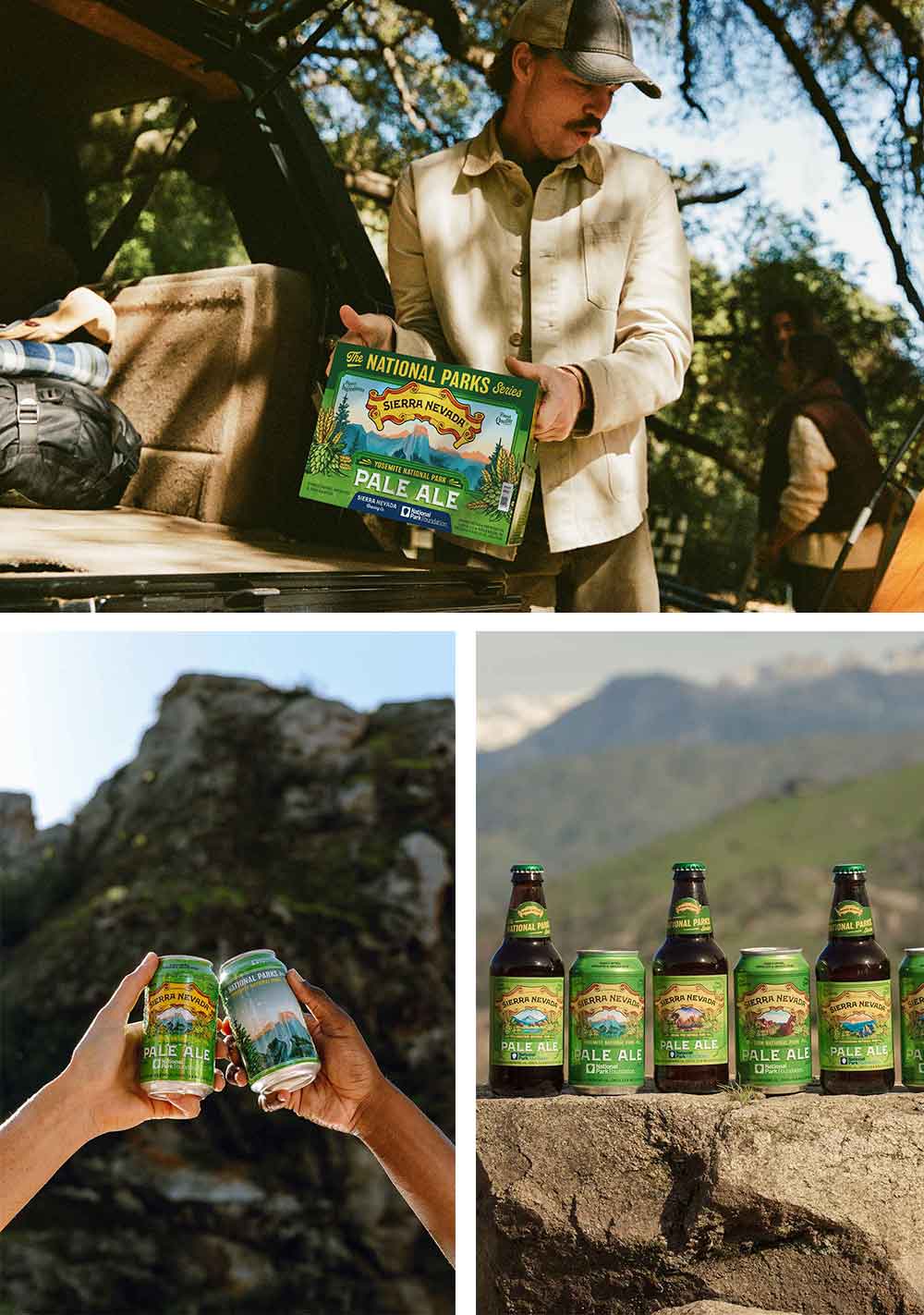
The collaboration included updating Sierra Nevada Pale Ale packaging with full-color illustrations of five of America’s most treasured national parks.
But this year, building on its momentum, Sierra Nevada has done something for the first time ever—something in its over-four-decade legacy they said they’d never do…
They’ve changed the actual label on their iconic Pale Ale bottles and cans.
All because they believe our national parks are something worth protecting.
A Delicate and Delicious Ecosystem
Photography courtesy of Sierra Nevada Brewing Company
If you nicked one of Sierra Nevada’s arteries, a delicate and delicious ecosystem would trickle out.
Since founder Ken Grossman started Sierra Nevada Brewing Company in 1980, the brewery named after one of California’s most iconic 400-mile-long mountain ranges, has been a steward of the outdoors.
“We’re named after the Sierra Nevada Mountains because that is Ken’s happy place,” says Sierra Nevada Brewing Company Chief Sustainability and Social Impact Officer Mandi McKay, who joined the brewery fresh out of college seventeen years ago. “We’ve been tied to nature from day one.”
Grossman baked his views of sustainability and the outdoors into Sierra Nevada, cobbling together old dairy and Coca-Cola bottling equipment to first get the brewery off the ground.
Over four decades later, Sierra Nevada has grown into the second-largest craft brewery in the country (Brewers Association). But its roots in the ground—like the rings in a California coast redwood tree—remain unchanged.
“With Ken, everything is about no waste. If something’s leaving, it should be a resource to something else because that’s how nature works,” says McKay. “His whole life, he has understood the power of the outdoors…the importance of preservation, the importance of people being outside.”
The Platinum True Zero Waste-Certified brewery considers everything coming into the brewery and how it can be reused.
For instance, every possible roof space across Sierra Nevada’s Chico, CA, and Mills River, NC, facilities has solar panels, generating 2.5 megawatts of solar power between the two spaces.
“We’re generating as much power ourselves as we can,” says McKay, noting the brewery has been doing that for over fifteen years.
Another resource, heat or steam, gets recycled into hot water for the next batch. And water, which you need a lot of to make beer, gets sent to an on-site wastewater treatment plant, where Sierra Nevada collects biogas to reuse for microturbines or to generate its own boilers.
“We’re truly making electricity for the brewery from our wastewater,” explains McKay, who could spend hours talking about Sierra Nevada’s sustainability efforts.
Last year, the first production brewery in the country to achieve LEED Platinum certification, the highest level in a program that recognizes companies that’ve met top-tier sustainability, energy efficiency, and low-environmental impact standards, launched Hop Forward.
The new ambitious commitment to conservation outlines the brewery’s sustainability ambitions through 2030, including a partnership with the National Parks Foundation through one of its most iconic flagships—Sierra Nevada Pale Ale.
For Decades, Don’t Touch Pale Ale
Photography courtesy of Sierra Nevada Brewing Company
Starting to homebrew in 1969, Grossman opened a homebrew supply store in 1976, then incorporated Sierra Nevada Brewing Co. in 1978 and released its first beer in 1980—actually a stout.
What came second?
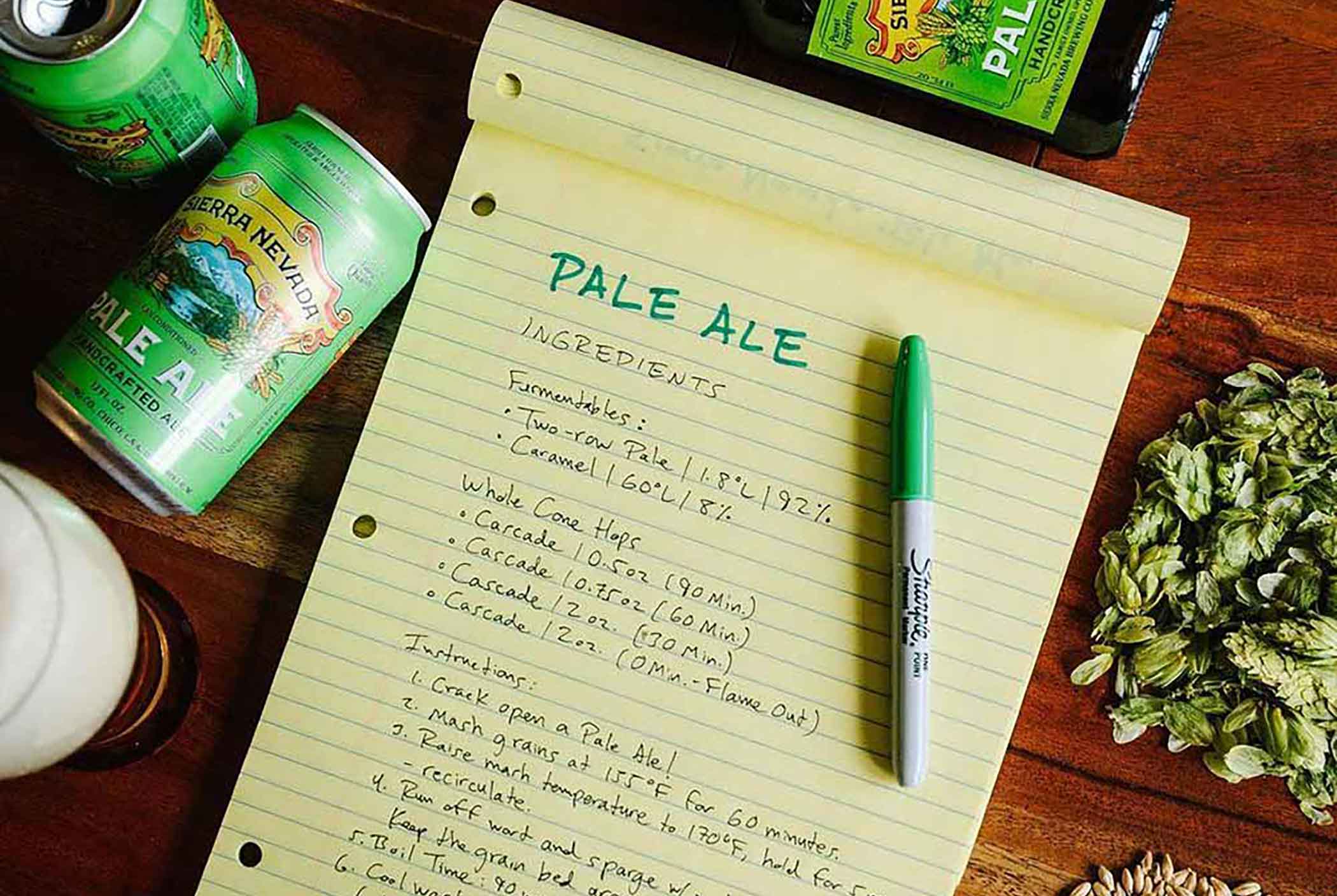
Sierra Nevada Pale Ale, a recipe Grossman honed through years of homebrewing, tweaking the hops, trying different water treatments, and experimenting with yeast strains.
Although he dumped the first ten commercial batches of Pale Ale, Grossman eventually nailed the scaled-up recipe.
A flagship was born. But it would be another ten years or so before Pale Ale became known like it is today.
Why?
Because the then-bracingly bitter Pale Ale was unlike anything anyone had ever tasted. Thanks to a new-at-the-time hop, Cascade.
In Sierra Nevada Pale Ale, Grossman throws Cascade in as the first addition in the kettle through to the last addition in the hop strainer. Used as both a bittering and aroma hop, Cascade gives distinct characteristics to Pale Ale.
At the time, clocking in at 38 IBUS, Pale Ale far outpaced anything else on the market in bitterness.
This beer was a banger. And today it stands as the epitome of the American pale ale style.
You don’t mess with a classic for a reason, so for Sierra Nevada, for the last forty-five years, there has been an unwritten rule:
“You don’t touch Pale Ale,” says McKay. “It’s an icon; it’s a flagship; it’s everyone’s favorite. You don’t mess with Pale Ale, right?”
But when the brewery partnered with the National Parks Foundation, everything changed.
Cold Beer, Warm Company
Photography courtesy of Sierra Nevada Brewing Company
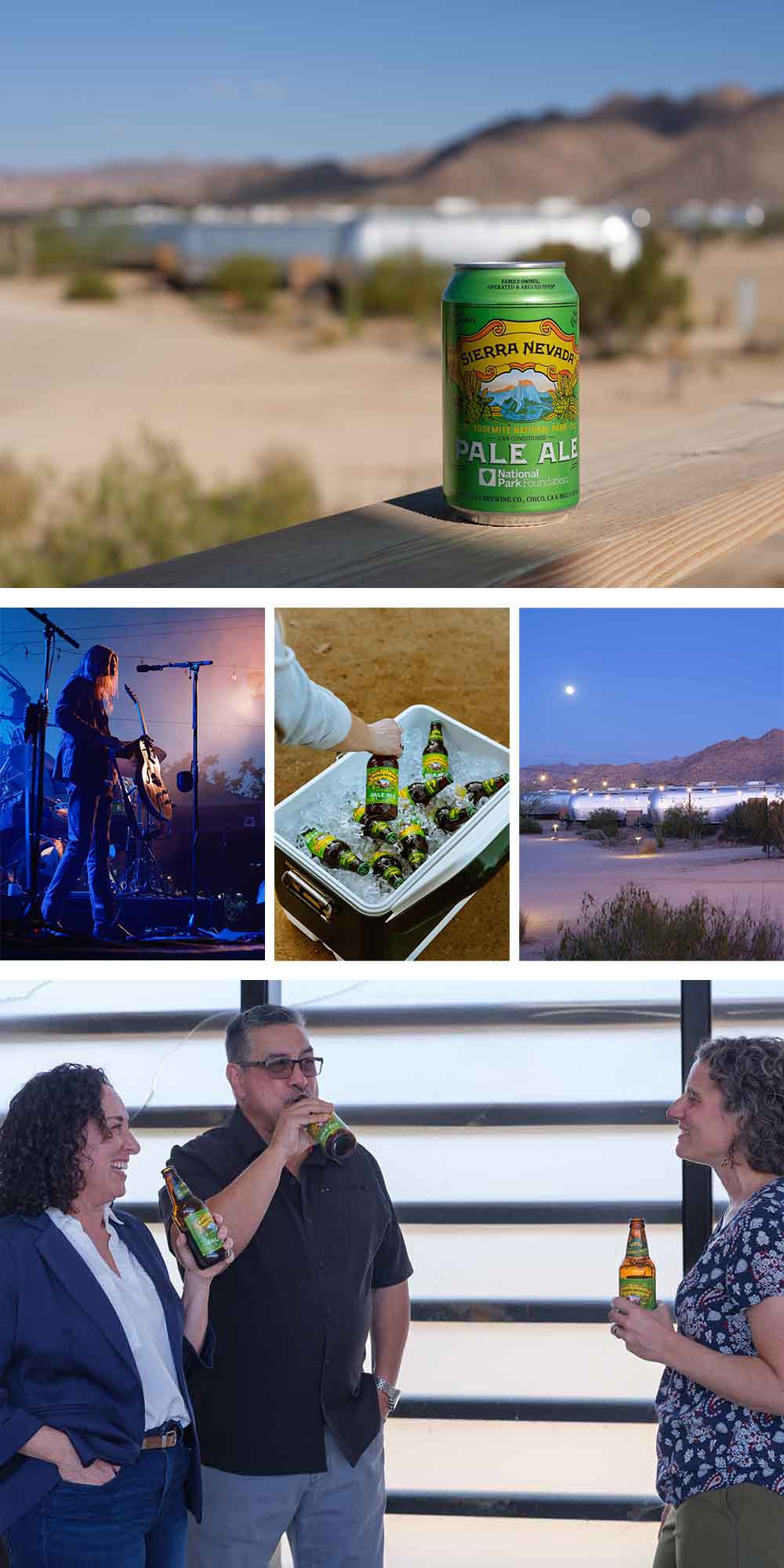
The bottle of Pale Ale sweating in my hand tastes like pine and citrus. Next to our picnic table, The Wood Brothers take the stage. Over the crooning notes of bluegrass, a pleasant cloud cover of human connection descends.
National Parks Foundation Vice President of Corporate Partnerships Rachel Gershwin sits next to me at the iconic Pappy & Harriet’s in Pioneertown, CA. She’s chatting with McKay like they were college roommates.
It’s the earned ease of two people who’ve connected over a shared passion, smiles cracking constantly like the bottles of beer around us.
The NPF VP, who grew up going to national parks, gets a pastoral spark in her eyes when she talks about “America’s best idea.”
Across 85 million acres of land and 430 sites, including national lakeshores, monuments, battlefields, recreation areas, and more, the National Park System welcomes over 300 million annual visitors.
“I think that’s more than every major sporting event combined,” says Gershwin, noting that every American lives within one hundred miles of a national park. “There are parks everywhere!”
But while the national parks don’t have a visitation problem, many people don’t know that these majestic protected spaces need support.
“Somewhere, somebody is drinking a bottle of Joshua Tree Pale Ale, and maybe it’s the first time they’ve seen Joshua Tree,” says Gershwin. “This partnership brings parks to people in such an authentic, unique, and creative way.”
If we want to keep leaving our footprints within parks’ borders, we need a blueprint for their protection and recognition, especially for those without well-known names like Yosemite and Yellowstone.
Although I’ve lived in Northern California for six years now and been to Palm Springs twice, I’ve yet to set foot in Joshua Tree.
Candidly, this partnership between Sierra Nevada and the NPF changed that.
Hopefully, changing the look of Pale Ale (even temporarily) will spark the imagination of many more across the country.
Because it’s an adventurous statement, right? Some might call changing a brewery’s iconic label crazy.
For this collaboration, Sierra Nevada calls it natural.
“This is the biggest and boldest partnership we’ve probably ever done,” says McKay, who reminds me that Sierra Nevada has a long history of supporting land conservation, protection, and access. “But at no point was anyone like, how could you ever propose this? It was more like, well, how big do we want to go?”
Go Big or Go to a National Park
Photography courtesy of Sierra Nevada Brewing Company
When Sierra Nevada first approached Gershwin about a potential partnership, it took over a year of vetting with the National Park Service, which gives an extra layer of scrutiny to alcohol brands.
“But they gave the green light because they saw Sierra Nevada was such an authentic brand, truly dedicated to sustainability and conservation,” says Gershwin. “It is such a perfect match.”
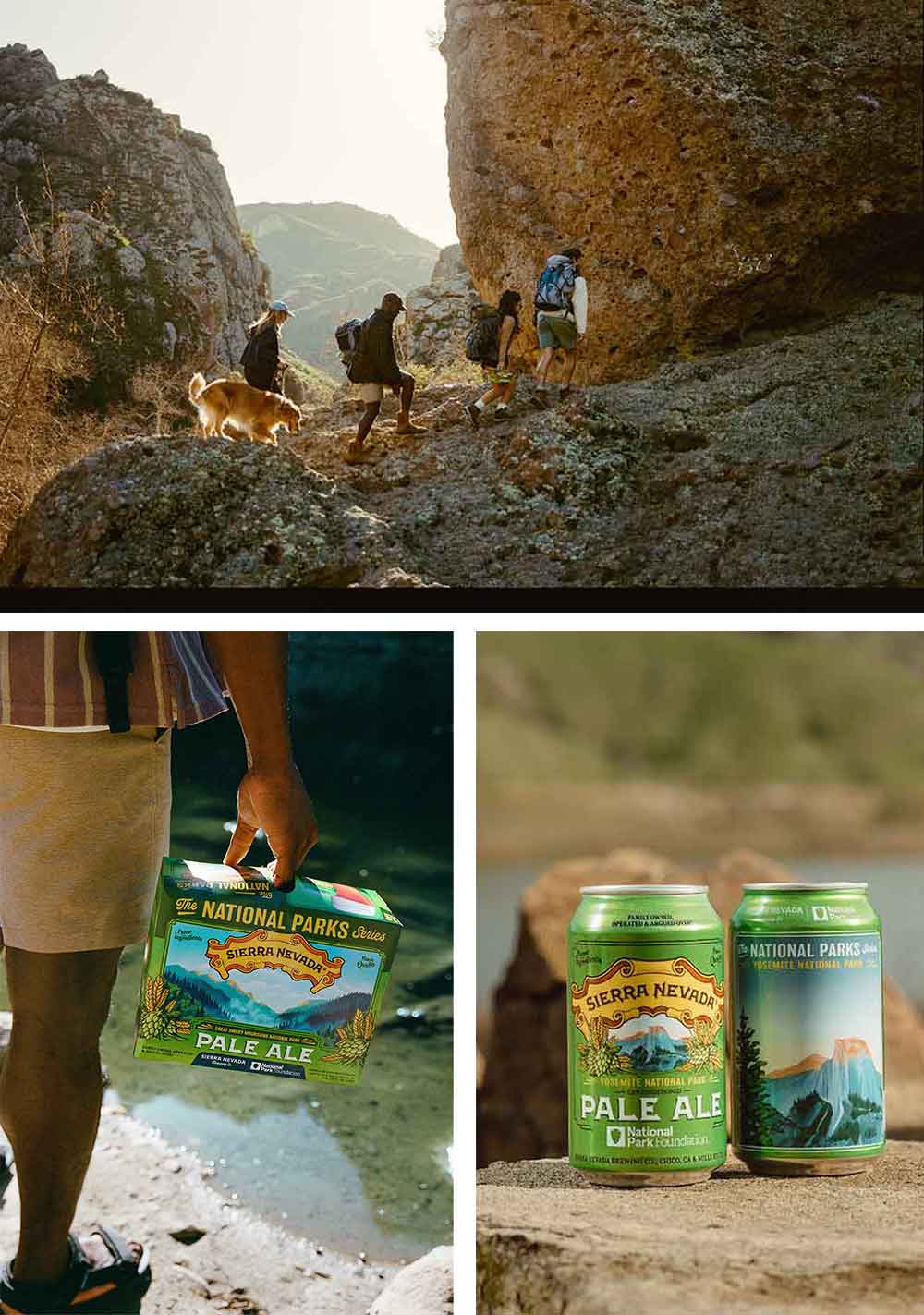
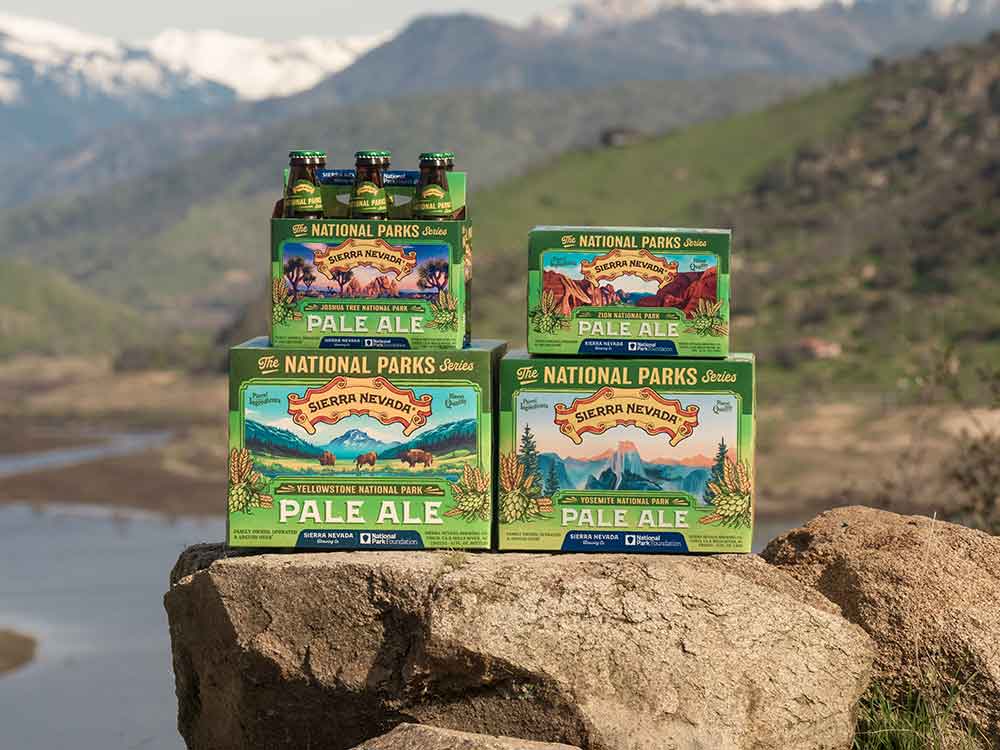
Officially launching in 2025, Sierra Nevada’s partnership with NPF included a temporary update to all package art on its Pale Ale carriers, featuring five national parks—Great Smoky Mountains National Park, Yellowstone National Park, Yosemite National Park, Shenandoah National Park, and Zion National Park.
The Northern California brewery also personally made a $350k donation to NPF.
“They’re putting their money where their mouth is,” says Gershwin.
Sierra Nevada and NPF chose parks to showcase a variety of the country’s regions where the legendary brewery has a presence.
This year, Sierra Nevada amped up its commitment, donating $500k to NPF, adding a new park—Joshua Tree National Park—and extending all of the national park art to its can and bottle labels.
“I’ve heard the words, we will never do that,” laughs McKay. “And we’re doing it.”
McKay added that Joshua Tree felt logical because, although it’s one of the most-visited national parks, it’s not an automatic top-of-mind one like Yosemite or Yellowstone.
Plus, as Gershwin points out, the landscape is so unique.
Something you can see right on the label, created in-house by Sierra Nevada Brand Designer Alan Ramire Mota.
A rock formation juts out underneath the iconic yellow Sierra Nevada banner. Flanked by the park’s namesake Joshua Trees, the scene seems caught either halfway between sunrise or halfway to sunset. Subtly striking, the illustration’s muted pastels draw you in before you even pop the top of the Pale Ale bottle or crack the can’s tab.
The hope is that Sierra Nevada’s most culturally relevant beer can bring recognition to America’s greatest wonders and treasures.
“Everyone knows about national parks, but they really forget how cool, how unique, and how important they are,” says McKay.
And most importantly, according to Gershwin, they forget that they need our support to stay alive.
Not that everyone is taking Sierra Nevada Pale Ale or our National Park System for granted, but sometimes even icons need a little polish to shine.
Polishing the Past, Sparkling in the Present
Photography courtesy of Sierra Nevada Brewing Company
Gershwin has another word for this collaboration: nostalgia.
People remember drinking their first Pale Ale as much as they do visiting their first national park.
“They’ve been here longer than us, right?” quips Gershwin
“And they’re going to be here [longer than us],” interjects McKay.
Back in Joshua Tree, we stand huddled around Conan, his infectious energy smacking us unabashedly in the face like sunlight gleaming off a shard of glass.
“The greatest gift I can give you is the present,” says the Palm Springs native, who calls himself a steward of the land.
When we stand in a national park, when we take a moment in the present to connect with the endless life humming around us, it’s like sitting down at a picnic table with a bottle of beer and a spread of barbecue before us.
We laugh, we might even cry, but we share, we mingle, we connect. That’s human nature…that’s nature itself.
To Sierra Nevada and the NPF, and hopefully now to you, that’s something worth protecting.
Where Can I Find the Limited-Edition Sierra Nevada Pale Ale?
Photography courtesy of Sierra Nevada Brewing Company
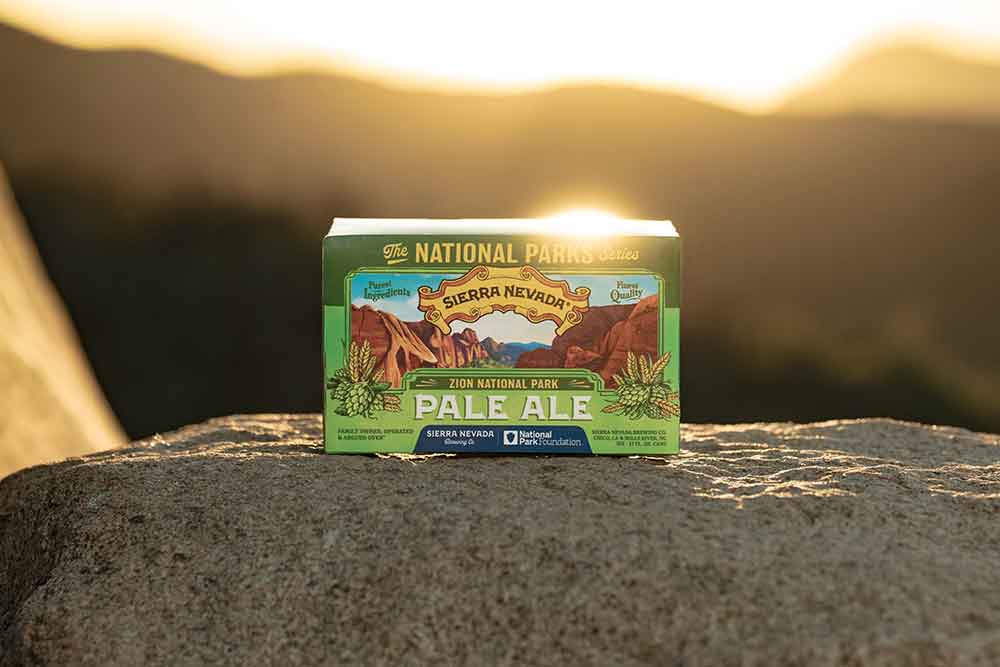
You can enjoy the full-color illustrations of six of America’s national parks on Sierra Nevada Pale Ale 12-pack and 6-pack cans, bottles, and cartons through July and across all of the brewery’s national footprint.
To find a Sierra Nevada Pale Ale near you, visit Sierra Nevada’s Brew Finder.
Additionally, fans can enter a sweepstakes for a chance to win a trip to an AutoCamp location of their choice, including travel, lodging, and a VIP experience.

About The Author
Grace Lee-Weitz
Currently Drinking:
Fort Point Beer Co. KSA
Grace is the Senior Content Editor for Hop Culture and Untappd. She also organizes and produces the largest weeklong women, femme-identifying, and non-binary folx in craft beer festival in the country, Beers With(out) Beards, and the first-ever festival celebrating the colorful, vibrant voices in the queer community in craft beer, Queer Beer. An avid craft beer nerd Grace always found a way to work with beer. After graduating with a journalism degree from Northwestern University, she attended culinary school before working in restaurant management. She moonlighted as a brand ambassador at 3 Sheeps Brewing Co. on the weekends before moving into the beer industry full-time as an account coordinator at 5 Rabbit Cerveceria. Grace holds her Masters degree in the Food Studies program at NYU.